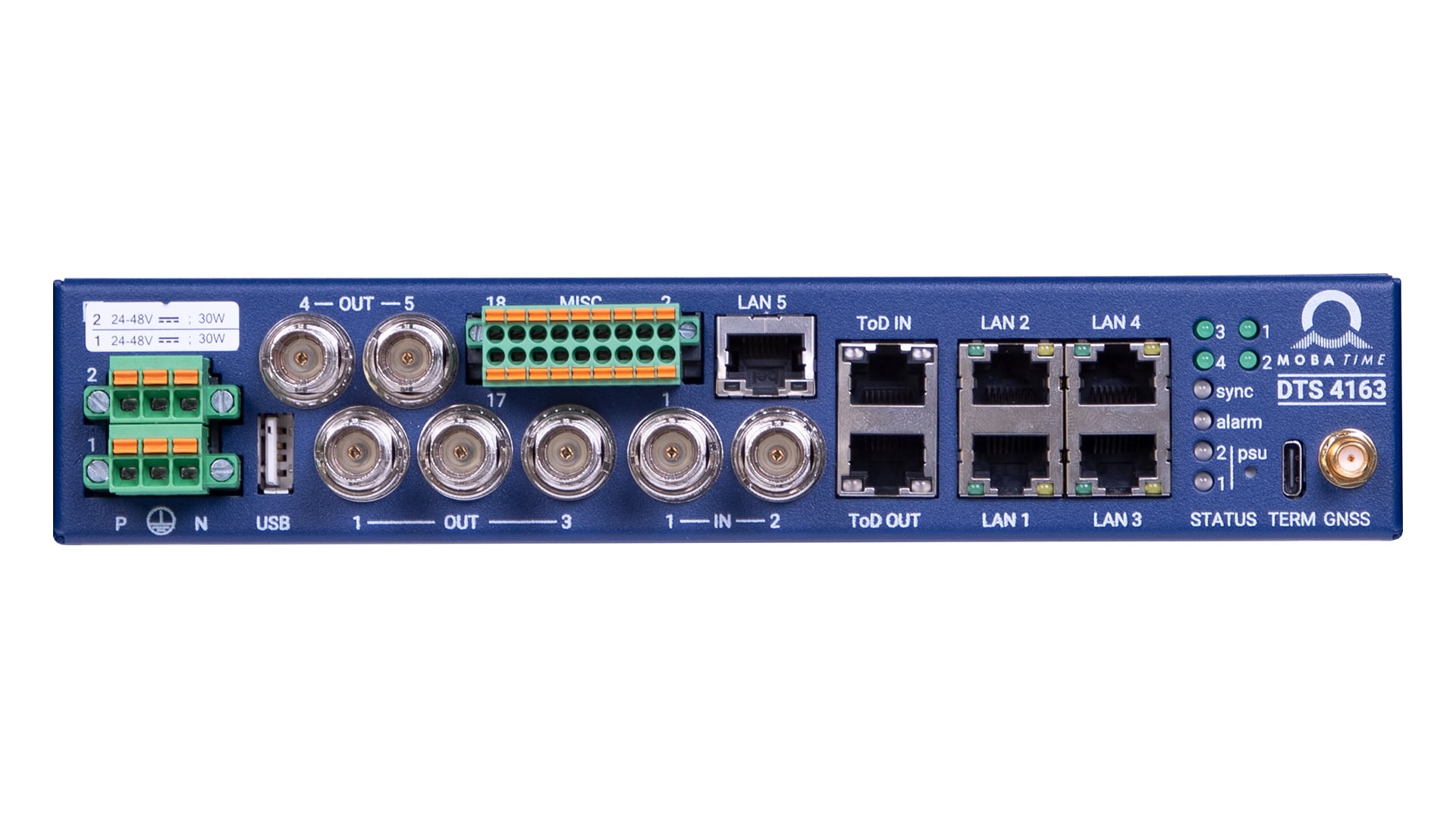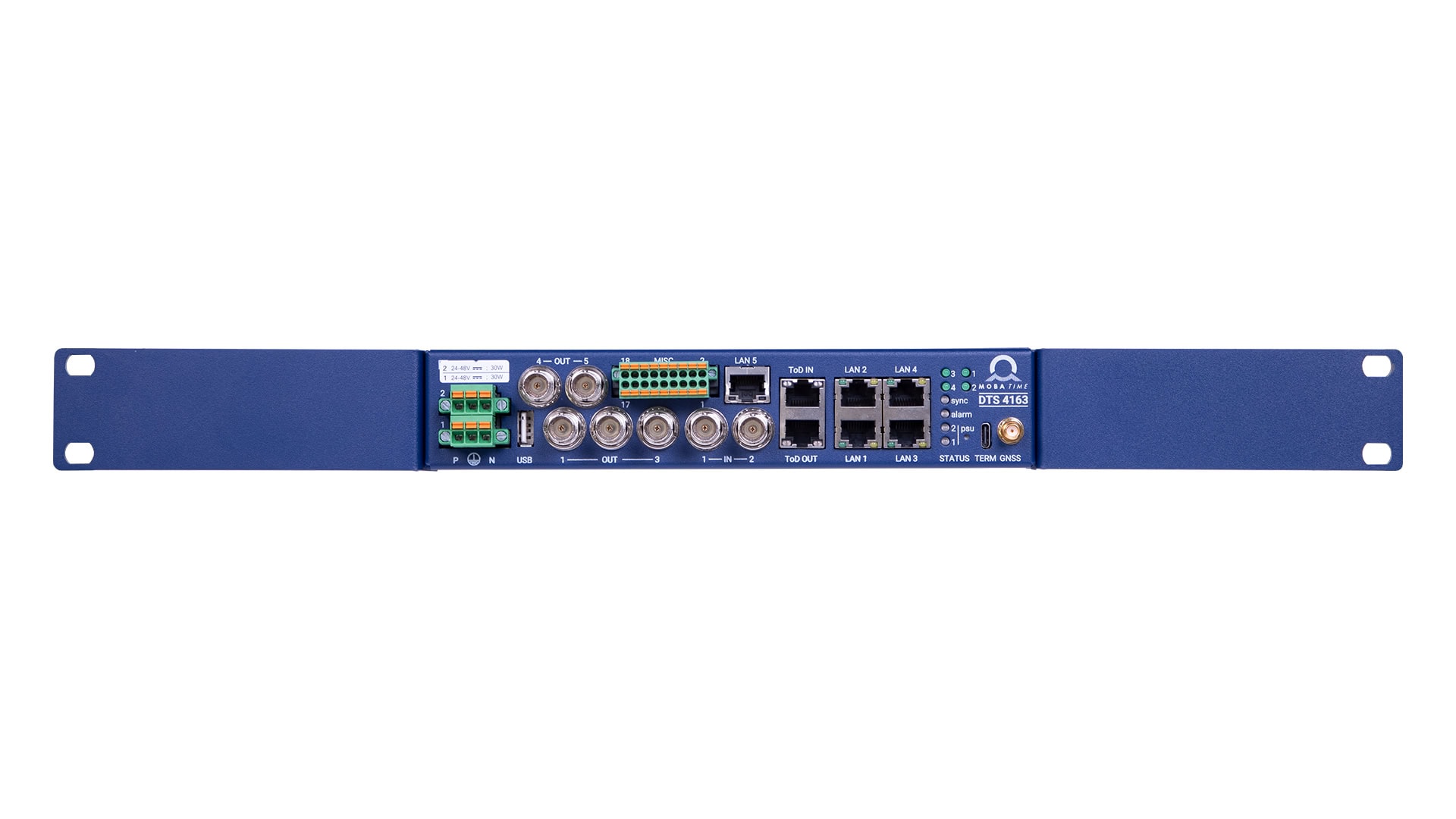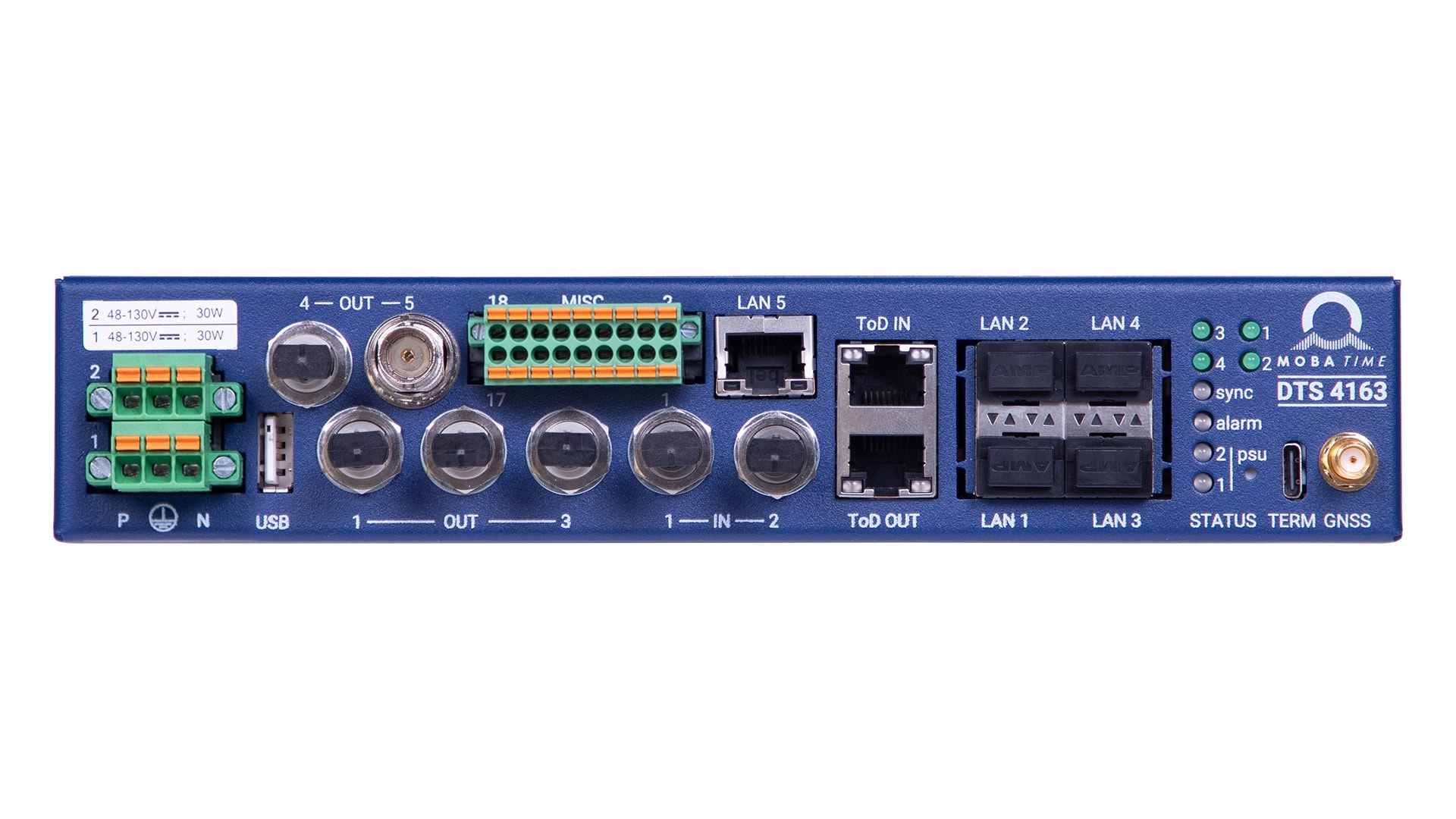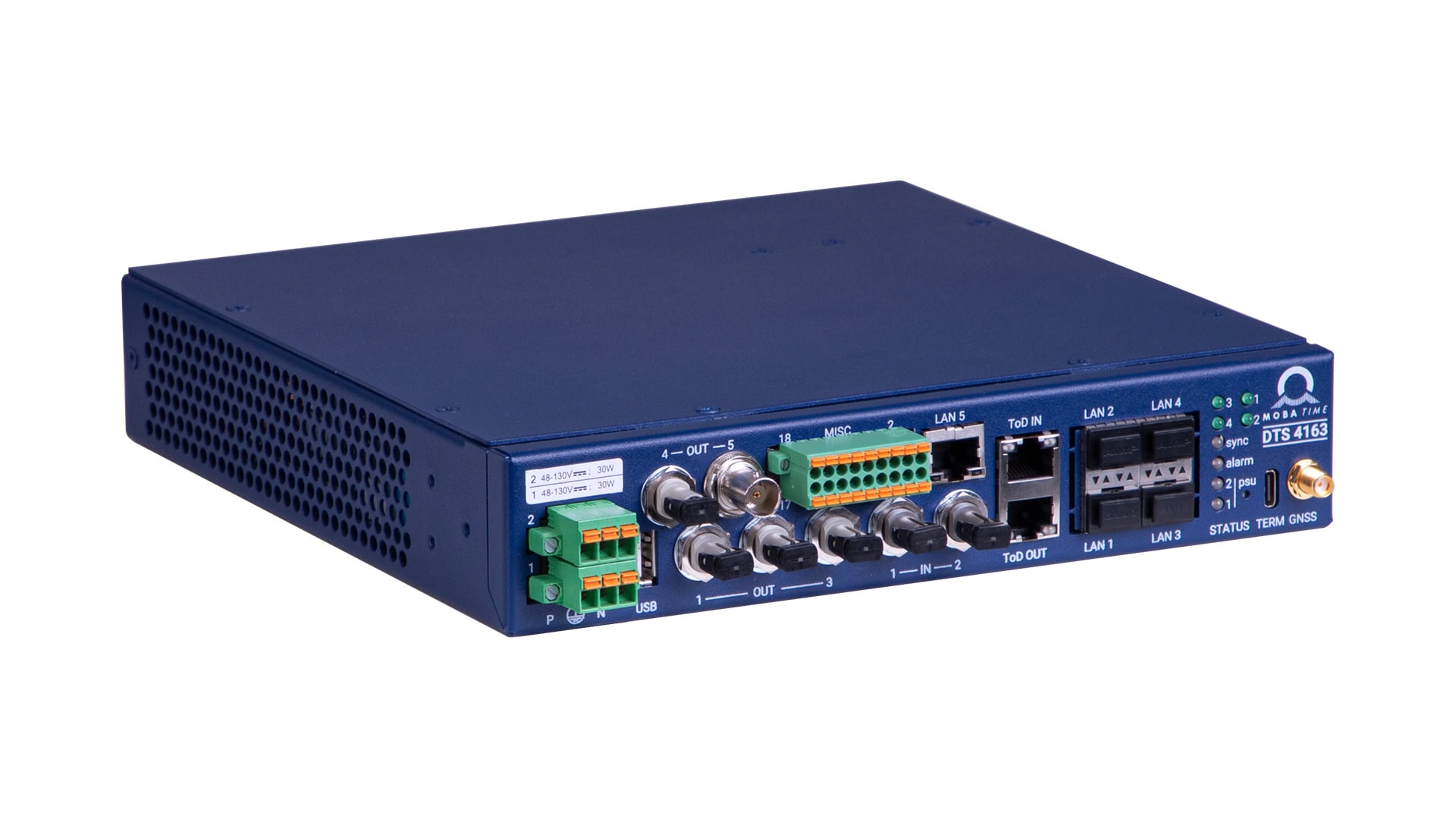




IEEE-1588 PTP Grandmaster - DTS 4163
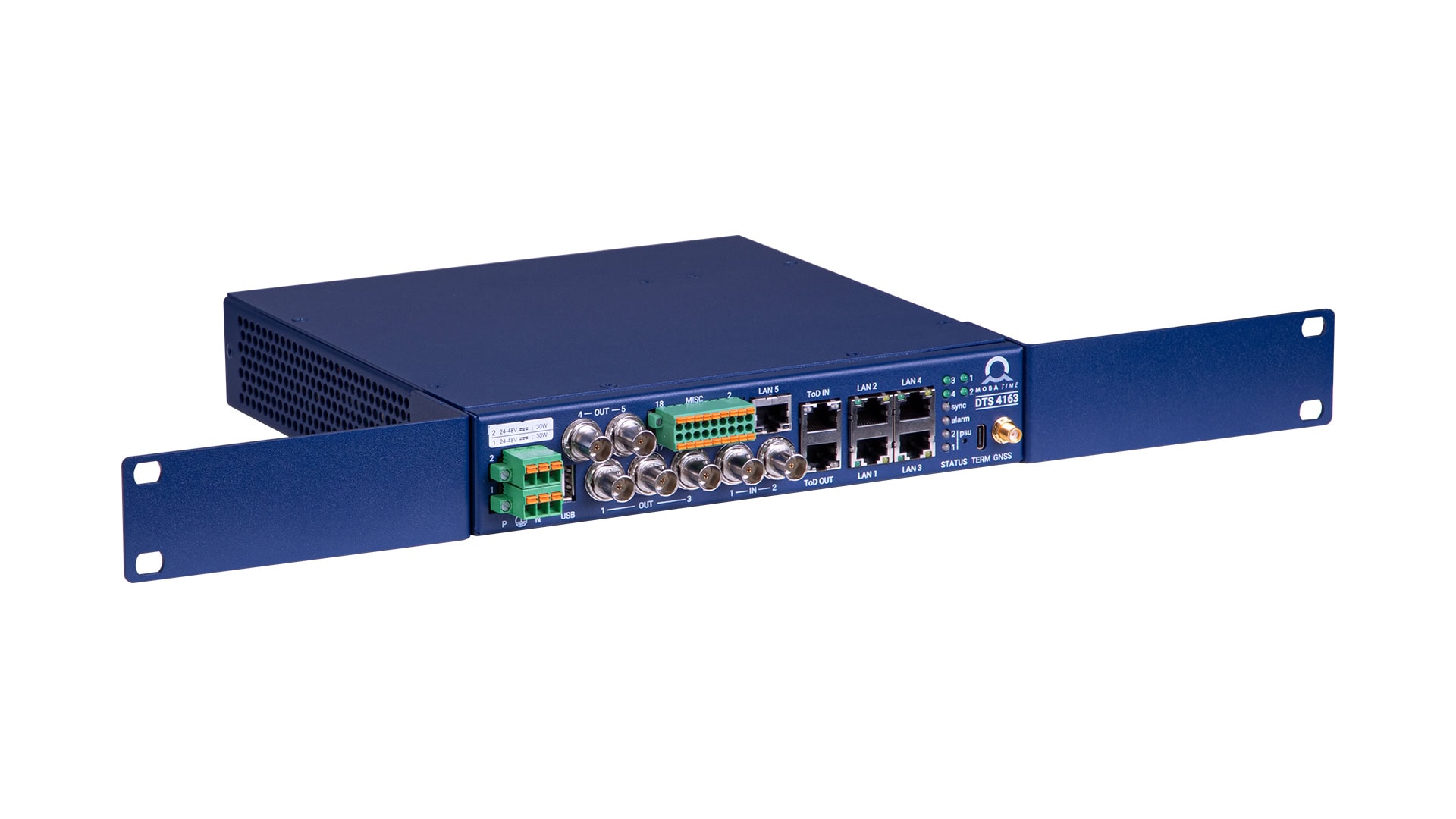
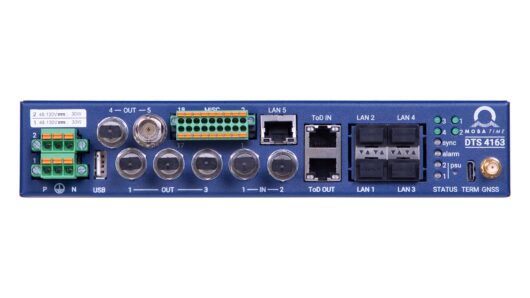
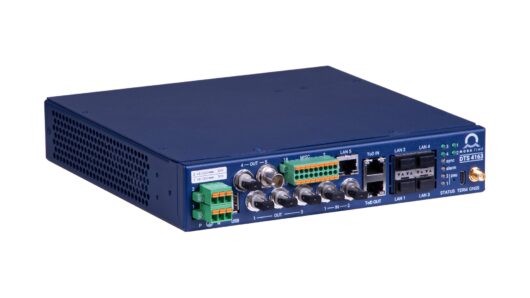
IEEE-1588 PTP Grandmaster - DTS 4163
Le DTS 4163.grandmaster est un grandmaster PTP spécialement conçu pour les sous-stations numériques conformément aux normes suivantes IEC 61850. Grâce à sa haute précision et à son fonctionnement redondant sans faille, il offre un haut degré de fiabilité et de disponibilité.
Grand maître PTP pour les postes numériques IEC 61850
Le DTS 4163 est une horloge de référence primaire(PRTC) et un grand maître PTP conforme à la norme IEEE 1588-2008 / PTPv2, avec compatibilité IEEE 1588-2019/ PTPv2.1, pour une synchronisation extrêmement précise des clients.
Prise en charge PRP/HSR
Le DTS 4163 est doté d’une paire d’interfaces redondantes(PRP/HSR) permettant de connecter directement l’appareil en tant que DAN (dual attached node) avec une bande passante complète de 1 Gbps.
Gigabit Ethernet complet
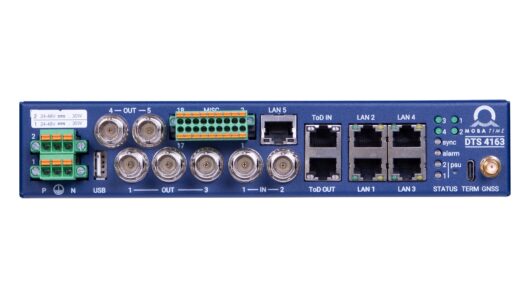
Offre 4 ports Gigabit Ethernet entièrement compatibles PTP (RJ45 ou SFP), chacun prenant en charge 1 étape/2 étapes, multicast/unicast, IPv4/IPv6, Layer 2, et des configurations de domaines/profils indépendants – idéal pour les réseaux segmentés modernes.
Cybersécurité
Conçu dans un souci de sécurité, le système est doté d’un démarrage sécurisé, de données utilisateur cryptées et d’un micrologiciel signé. Il prend en charge l’accès sécurisé via SSH, SCP, SFTP et HTTPS (bientôt), conformément aux normes IEC 62443-4-2.
Serveur NTP haute performance
Le DTS 4163 peut répondre à plus de 10’000 requêtes NTP et SNTP par seconde (jusqu’à 600’000 clients selon la configuration du client NTP).
Récepteur GNSS
Le DTS 4163 peut recevoir simultanément tous les systèmes GNSS L1 (GPS+QZSS/SBAS, Galileo, GLONASS, BeiDou), garantissant une précision et une disponibilité optimales.
Capacité d’horloge frontière
Le DTS 4163 peut être utilisé comme horloge frontière pour relier différents domaines temporels à l’aide de deux serveurs PTP externes et desservir jusqu’à quatre autres domaines avec des clients.
Options d’oscillateur
Le DTS 4163 offre différentes options d’oscillateur, permettant d’améliorer les performances de maintien et la stabilité à long terme en fonction des besoins de l’application.
Sorties traditionnelles
Les sorties du DTS 4163 prennent en charge de nombreux signaux traditionnels tels que IRIG, ToD, DCF, impulsion et fréquence.
Système de gestion du réseau
Le DTS 4163.grandmaster peut être entièrement surveillé, configuré et contrôlé à l’aide du logiciel Mobatime Network Management System(MOBA-NMS).
| Type d'oscillateur : | TCXO / OCXO / Rubidium |
|---|---|
| Interface réseau : | 4x 100/1000BaseT (LAN 1-4) ou 4x SFP pour module miniGBIC l, 1x 100/1000BaseT (LAN 5) gestion |
| Caractéristiques du réseau : | PTP grand maître / SyncE maître / NTP V4/V3, serveur (RFC 5905/1305) / SNTP (RFC 4330), Configuration IP : IPv4 (DHCP, IP statique), IPv6 (autoconfiguration, DHCPv6, IP statique), Agrégation de liens (IEEE 802.3ad) sur 2 / interfaces LAN dédiées (LAN 2 & 3), VLAN : priorisé (IEEE 802.1p), tagged (IEEE 802.1Q), routage statique, IGMP / Multicast (RFC 3376, 1112, 4601, 3973), authentification des utilisateurs avec Radius (RFC 2865), LDAP (RFC 4511) et LDAP sécurisé (RFC 4513) |
| Entrées du signal de référence | 1x entrée RF GNSS (pour antenne GNSS) vers récepteur GNSS interne, 92 canaux, poursuite, sensibilité -167 dBm, 2x PTP (d'un autre grand maître PTP, en tant qu'esclave PTP), 1x boucle de courant DCF (par ex. GNSS 4500), 2x F-IN (1 PPS, 10 MHz, 2,048 MHz) (pour l'amélioration du maintien uniquement) |
| Sorties de signaux de référence (réseau) | PTP grand maître (E2E, P2P, 1 étape, 2 étapes, multicast, couche 2, IPv4/IPv6) (LAN 1-4), profils PTP : E2E/P2P par défaut ; utilitaire d'alimentation (IEEE/IEC 61850-9-3) ; télécom ITU-T G.8265.1, G.8275.1, G.8275.2 ; gPTP IEEE 802.1AS, maître SyncE, ESMC (SSM), serveur NTP (>10'000 requêtes/seconde sur les 4 ports combinés), mode NTP : Serveur, Peer, Broadcast, Multicast / SNTP / Authentification MD5 et SHA1 pour NTP, TIME (RFC 868), DAYTIME (RFC 867) |
| Sorties de signaux de référence (hors réseau) | 3/4x sortie impulsion/fréquence/signal de précision, (1PPS à 10 MHZ ou IRIG-B 00x), 1x IRIG-B-12x AM analogique, 1x ToD, 2x sortie série, RS-422, 2x interrupteur d'événement configurable, 2x timestamper d'événement |
| Profils PTP | Profils par défaut : E2E IEEE 1588-2008, P2P IEEE 1588-2008 | Profils d'alimentation : IEEE C37.238-2011, IEEE C37.238-2017, IEC/IEEE 61850-9-3 | Profils de télécommunications : ITU-T G.8265.1, ITU-T G.8275.1, ITU-T G.8275.2 | AVB/TSN : IEEE 802.1AS |
| Alarmes | Interrupteur électrique : contact de relais, sorties réseau (LAN 1-5) : Notifications SNMP (Traps) V2c, Mail (RFC 4954, 2195), LED d'alarme, Syslog (RFC 5424) |
| Gestion et supervision | MOBA-NMS ; surveillance possible, Menu terminal : Terminal USB-C, SSH, SNMP (v1/v2c/v3), SNMPv3 avec authentification et cryptage, Syslog (RFC 5424), téléchargement du firmware du système via SCP, SFTP ou USB, LEDs : Alarme, Alimentation, Synchronisation, Prochainement : interface web |
| Sécurité | Sécurité dès la conception : sécurité matérielle (démarrage sécurisé), données utilisateur cryptées, image firmware cryptée et signée, accès sécurisé à l'appareil avec SSH, SCP, SFTP, HTTPS (bientôt), caractéristiques de sécurité conformes à la norme IEC 62443-4-2. |
| Dimensions : | 222 x 44 x 222 mm (avec kit de rack : 483 x 44 x 222 mm, 19'', 1U) |
|---|---|
| Poids | Environ 2,0 kg (selon la version) |
| Matériau du boîtier | Acier (revêtement en poudre) |
| Degré de protection | IP 20 |
| Température de fonctionnement | -20 - 50 °C |
| Humidité de fonctionnement | 5 - 95% relative, sans condensation |
| Refroidissement | Options de refroidissement actif ou passif (sans ventilateur) disponibles |
| Alimentation électrique | Selon la version |
| Conformité | Le DTS 4163.grandmaster est conforme aux homologations suivantes : CE, UKCA, CB, RoHS, WEEE, EMC : IEC 61850-3, IEC 61000-3-2, 61000-3-3, IEC 61000-6-2, 61000-6-4, Safety : IEC 62368-1 |
| Précision, interne (valeurs typiques) | GNSS vers temps interne : < +/- 50 ns, PTP vers temps interne : < +/- 50 ns, DCF vers temps interne (avec GNSS 4500) : < +/- 50 ns (après compensation du décalage de la position), F-In vers temps interne : < +/- 50 ns (fréquence uniquement) |
| Précision, sortie du signal temporel (valeurs typiques) | GNSS vers NTP : < +/- 100 μs, GNSS vers impulsion/fréquence : < +/- 50 ns, GNSS vers IRIG (AM) : < +/- 200 μs, GNSS vers IRIG (DC) : < +/- 50 ns, GNSS vers sortie série : < +/- 10 ms (Jitter <10 ms) |
Leaflets
 LE-801302.20-DTS 4163-grandmaster.pdf
 Manuals
HSR (High-availability Seamless Redundancy) is a fault-tolerant Ethernet protocol specified in IEC 62439-3, designed for applications where continuous data transmission is critical. It operates using a ring or mesh topology, where each node simultaneously sends duplicate Ethernet frames in both directions. This ensures that even if one link fails, the other path still delivers the data with zero recovery time, making HSR highly suitable for real-time, mission-critical systems such as substation automation, industrial control, and transportation.
A key difference between HSR and PRP (Parallel Redundancy Protocol) lies in their network topology and implementation approach:
-
HSR uses a single network infrastructure with a ring or mesh configuration, allowing for compact or space-constrained installations without the need for separate switches or links. Each device must be HSR-capable and interconnected in the ring.
-
PRP, by contrast, requires two completely separate LANs (LAN A and LAN B), with each device transmitting duplicate frames over both networks.
Only few devices like the DTS 4163.grandmaster support both HSR and PRP protocols as defined in IEC 62439-3. This allows the device to be used in a range of redundant network configurations, including HSR ring topologies, PRP dual-network setups, and in some cases, hybrid environments.
PRP (Parallel Redundancy Protocol) is a fault-tolerant Ethernet protocol defined in IEC 62439-3. It ensures zero recovery time by transmitting identical Ethernet frames simultaneously over two separate and independent LANs—referred to as LAN A and LAN B. Each PRP-capable device uses two network interfaces and remains fully operational even if one of the networks fails. The receiving device accepts the first-arriving frame and discards the duplicate, avoiding retransmissions or delays and maintaining uninterrupted communication.
Compared to HSR (High-availability Seamless Redundancy), PRP offers full physical separation of network paths, which provides enhanced fault isolation and the ability to reuse existing network infrastructure. However, this comes at the cost of double the cabling, switches, and ports, which can increase system complexity and space requirements.
-
PRP is ideal for larger or existing installations where dual independent networks are already in place or where redundancy with maximum physical separation is required.
-
HSR, in contrast, uses a single-ring or mesh topology and achieves redundancy by sending duplicate frames in opposite directions through the same network infrastructure, making it more suitable for compact, distributed systems.
Only few devices like the DTS 4163.grandmaster support both HSR and PRP protocols as defined in IEC 62439-3. This allows the device to be used in a range of redundant network configurations, including HSR ring topologies, PRP dual-network setups, and in some cases, hybrid environments.
PTP profiles are standardized sets of configuration parameters tailored to specific industries or use cases. For example:
- The Power Profile (IEC 61850-9-3) is used in substations and utility automation, prioritizing reliability and deterministic behavior.
- The Telecom Profiles (ITU-T G.8275.1 and G.8275.2) are used in mobile networks for phase and frequency synchronization.
These profiles ensure interoperability and simplify deployment within each domain.
The Precision Time Protocol (PTP), defined by IEEE 1588, is a network protocol that synchronizes clocks throughout a network with sub-microsecond accuracy. It is critical in applications where precise timing is essential, such as energy systems, industrial automation, financial trading, and broadcasting. PTP achieves this high accuracy through hardware timestamping and delay compensation techniques.
Such considerations are important for hierarchically structured time server structures. The stratum level “0” always refers to the time server on the top level, which functions as the reference time source of the overall system, for example, by means of exact DCF / GPS synchronization. The level below, along with the time servers located there – which in turn synchronize themselves to level « 0 » – is given the stratum level « 1 » accordingly. Levels further below therefore add up the stratum level “n + 1”. As a rule, a maximum of 16 stratum levels are defined.
You’ll find it directly on the license web site – After entering the license number and filling out the registration form you will be able to download the license file and the newest MOBA-NMS software 32-bit or 64-bit version.
Link to the license page: https://nms-webportal.mobatime.com/license/login
To get a valid license you need to order a MOBA license from us. As soon as we receive the request, we will send you a PDF including the license key. In the PDF you will find a link, which leads to a landing page of us, which asks you to enter the license key. As soon as you have entered the key, your license is activated.
ATTENTION: a license is only for one workstation and should be activated by the responsible employee.
As a rule, NTP clients send a request packet every 64 seconds at most. With a device code of 100 “requests per second”, 6,400 NTP clients could already be synchronized in the network. For example, if you use the DTS 4160 time server with 10,000 « requests per second », there are even 640,000 clients that could be synchronized with this type of time server in the network. Since more current NTP versions increase the polling interval by a factor of 16 with stable time synchronization, this results in an even greater number of possible NTP end devices. One should therefore take this fact into account when selecting the device specification that is really necessary for the specific need. For larger networks, it is also common that hierarchical time server structures – consisting of several network segments or levels, each with an assigned time server – are created. In this way, the time servers of the lower level always synchronize to the higher level right down to the central time server. This central time server typically has the highest performance features and is often redundant.
Our tutorial videos will help you with the procedure for commissioning a DTS device in a network without dynamic IP address assignment DHCP. You will be shown how to make the settings on the DTS device and how to assign the IP address.
What is supplied by MOBATIME?
- DTS device (e.g. DTS 4801.masterclock)
- Rack mounting material
- Terminal opener-tool
What do you need to be ready?
- PC or Laptop
- Switch
- Serial cable (SUB.D9 pole, 0-modem (crossed))
- USB Serial Adapter (only if you don’t have a serial input on your device)
- Power cable
- Network (LAN) cable
You need to download the following software:
- PuTTY
- MOBA NMS !Attention, you need a valid license! (How to I get a valid MOBA-NMS licence?)
Below you will find our six tutorial videos that will help you complete the initial installation:
- Identify PC COM Port
- Open PuTTY
- Configuration of DTS Menu IP in PuTTY
- Define PC/Laptop IP
- Add Single Device in MOBA-NMS
- Select synchronization source in MOBA-NMS